Not all leaders lead the same way. Understanding your DISC leadership styles isn’t just self-awareness – it’s the beginning of actual change.
Most leadership programs tell you what great leadership looks like. Very few stop to ask what kind of leader you actually are.
That’s the gap. And it’s an expensive one – measured in attrition, disengagement, and teams that somehow can’t get it together no matter how many offsite retreats they attend.
Here’s something worth saying plainly: you can attend every workshop and read every management book on the shelf and still be genuinely difficult to work for. Because effectiveness as a leader isn’t just about what you know. It’s about how you naturally behave – and whether that behavior is helping or quietly undermining the people around you.
That’s exactly where disc leadership styles change things. They give you a behavioral framework – grounded in validated research, not gut feel to understand how you lead, how your team experiences your leadership, and where your natural tendencies are quietly costing you performance.
What DISC Is and Why It Matters
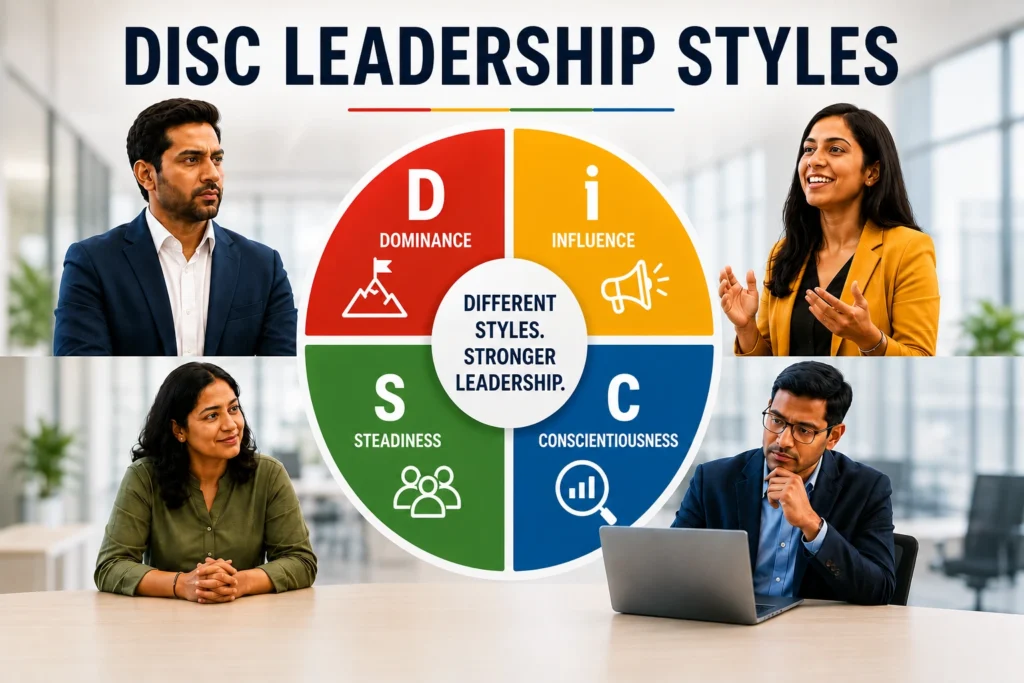
DISC is built around four core behavioral dimensions: Dominance, Influence, Steadiness, and Conscientiousness. It doesn’t measure intelligence or character. What it measures is how you naturally respond – under pressure, in conflict, when making decisions, and when navigating change. That’s exactly where things get real.
(If you’re looking for a foundational breakdown of what each DISC style means, our DISC Styles guide covers that in depth. This blog focuses specifically on how those styles play out in leadership contexts.)
In India’s evolving corporate landscape – where intentional leadership is increasingly expected to be both results-driven and emotionally intelligent – DISC fills a critical gap. HR leaders, L&D professionals, and CXOs across sectors are turning to disc leadership styles because they’re practical, culturally transferable, and backed by decades of rigorous research.
DISC Personality Types aren’t fixed categories. They describe behavioral tendencies – patterns that reveal themselves most clearly under pressure and in conflict. Understanding yours is the foundation of more deliberate, effective leadership.
What makes disc styles especially valuable in these contexts is this: the framework doesn’t stay abstract. Every DISC profile comes with specific, observable behavioral patterns – in how you communicate, respond to challenges, handle conflict, and influence others. That’s where development begins.
The Four Disc Leadership Styles - Without the Diplomatic Softening
Most descriptions of disc leadership styles are written so diplomatically that the hard truths disappear entirely. Let’s not do that here.
D-Style: Leadership That Drives and Sometimes Burns People Out
D-style leaders are decisive, direct, and fast. They take clear positions and push teams toward outcomes with genuine force. In India’s competitive, target-driven corporate culture – sales-heavy organizations, high-growth startups, turnaround situations – this kind of leadership often gets celebrated.
But here’s the uncomfortable observation: when D-type leaders operate without self-awareness, they build fear cultures. Teams stop bringing bad news. People manage up instead of contributing honestly. Revenue targets get hit, and nobody mentions that three of the strongest performers quietly updated their LinkedIn profiles last month.
The DISC style for leadership that D-types bring is genuinely powerful in a crisis, in moments requiring decisive clarity, or when a team is drifting without direction. But this leadership style reaches its ceiling fast without self-awareness, the ability to listen, and real investment in other people’s growth.
i-Style: Inspiring Leadership That Needs a Backbone
i-style leaders are magnetic. They communicate vision with contagious energy and build cultures people actually want to be part of. In roles requiring collaboration, culture-building, or rallying teams through change, they often outperform most other disc styles.
But here’s what doesn’t get said clearly enough: i-style leaders struggle with follow-through. The natural desire to be liked – which is genuine to this style, not performative – makes hard conversations feel almost impossible. Hard conversations aren’t optional.
Among all the disc styles, i-types are perhaps the most visible leaders. They’re also often overrated in the short term. When energy isn’t backed by discipline and real accountability, the team starts carrying the weight of what was promised but never delivered.
The DISC style for leadership that i-types bring works best when vision is matched with clear metrics and inspiration is matched with the willingness to follow through on the difficult conversations.
S-Style: Steady Leadership With a Blind Spot for Conflict
S-style leaders are the quiet builders. Loyal, empathetic, consistent. Teams led by S-style leaders tend to have genuine trust, low interpersonal friction, and strong psychological safety. In India’s deeply relationship-oriented work culture, this leadership style resonates enormously.
You’ll recognize this kind of leader: the manager who remembers every team member’s hometown, who notices when someone seems off in the morning meeting, who builds real relationships through months of consistent presence rather than transactional exchanges. That’s rare and genuinely valuable.
But disc leadership styles that lean heavily toward S carry a specific risk: conflict avoidance that quietly becomes organizational dysfunction. S-type leaders often wait too long to address performance issues, letting tension accumulate until something breaks. In fast-moving organizations, their preference for stability can look like resistance to change – even when that’s not the intent.
This style demands one thing above all else: the courage to step into discomfort. Not aggression – just the willingness to have the hard conversation before it becomes a crisis.
C-Style: Rigorous Leadership That Can Feel Remote
C-style leaders are meticulous. Their standards are high and their thinking is thorough. In roles where quality, compliance, and analytical depth matter – finance, engineering, research, operations – C-style leadership is often the most effective available.
But C-type leaders are the least likely to get visible credit for their contributions, largely because they lead quietly. Without the rallying energy of D-types or the warmth of S-types, C-style leaders can be perceived as cold, hard to please, or disengaged – even when deeply committed.
Among disc styles, C-types build the most durable systems and the most rigorous processes. But leadership at scale requires bringing people into your thinking – explaining not just what you’ve decided, but why, in ways that connect with colleagues who don’t share your comfort with data and detail.
The DISC style for leadership that C-types bring is irreplaceable when paired with deliberate effort to connect, communicate openly, and acknowledge the human side of the work.
Discover Your DISC Leadership Style
Understanding your DISC leadership style is just the start. The real shift happens when you apply it to your team’s communication, conflict, and performance. With Everything DiSC® programs by BYLD, you get practical, research-backed tools to build self-awareness, strengthen leadership effectiveness, and create high-performing teams.
Explore Everything DiSC® for Your TeamWhat Disc Leadership Styles Actually Surface
Let’s be direct about what knowing your DISC profile does – and doesn’t – accomplish.
It doesn’t automatically make you better at leading. Nothing does that on its own. What it does is make your blind spots visible. Once you can see them, you’re accountable for them.
The D-type leader who believes their directness is “just efficiency” while their team is quietly afraid to bring bad news. The i-type leader who holds memorable town halls and avoids every performance conversation. The S-type leader who keeps the peace at the cost of progress. The C-type leader who writes airtight strategy nobody acts on because nobody was brought into building it.
Disc leadership styles surface these patterns. Not a label – a mirror. That’s the actual value.
And disc styles deliver the most when they become team-wide shared language. When everyone understands their own disc styles and those of their colleagues, communication sharpens, conflict becomes navigable, and leadership stops being a daily guessing game.
Disc Leadership Styles in India's Real Workplace
India’s leadership landscape is genuinely complex. You’re navigating generation gaps, regional diversity, language differences, and the tension between hierarchy and collaborative structures – often simultaneously, in the same organization.
Leadership approaches that work brilliantly in a fast-scaling Bengaluru tech startup may land completely differently in a legacy manufacturing firm in Pune, or a family-run enterprise in Ahmedabad where relationships and seniority carry enormous cultural weight.
Gen Z employees – growing fast as a proportion of India’s workforce – bring distinct expectations. They want transparency. They push back on authority. They have very little patience for leadership that can’t clearly explain its reasoning. Understanding disc leadership styles gives leaders a practical bridge across this generational divide without forcing anyone to abandon their authentic style.
In organizations scaling rapidly – which describes much of India’s mid-market right now – leadership teams need a shared behavioral vocabulary. Without one, every conflict gets attributed to personality. With disc styles as a shared language, teams can have far more honest conversations about how they’re actually working together and what genuinely needs to change.
The disc styles aren’t culturally neutral. Indian leadership contexts carry specific dynamics – the weight of hierarchy, the role of relationships in decision-making, the tension between collective harmony and individual accountability – that interact differently across each DISC profile. Skilled facilitation matters here more than the framework alone.
Style Blends: How DISC Really Shows Up in Practice
Most people don’t lead from a single pure style. They lead from a combination, and that blend matters more than either dimension alone. Here’s what the most common ones actually look like in practice.
DI: The Catalyst Leader
DI leaders are the ones who can sell the vision and drive the execution in the same breath. They move quickly, they’re persuasive, and people tend to follow them without needing to be convinced. You find this combination in a lot of founders and growth-stage leaders for exactly that reason.
The problem shows up when the energy outpaces the plan. DI leaders often launch before the strategy is ready, promise more than the timeline allows, and then move on to the next thing while the team is still cleaning up the last one. They also run fast in a way that genuinely wears out S and C-type colleagues who need more time and steadiness before they commit. If there’s one thing a DI leader needs to build deliberately, it’s patience with process, with people who think slower, and with the gap between a good idea and a working one.
DC: The Architect Leader
DC leaders are often the most capable people in the room and sometimes the hardest to work for. The D gives them drive and decisiveness. The C gives them high standards and analytical depth. Put those together and you get someone who sees problems clearly, holds the bar high, and moves with purpose. In operational leadership roles, COOs, engineering heads, turnaround situations, this combination tends to produce real results.
What it doesn’t always produce is a team that feels included. DC leaders process internally, decide efficiently, and move forward. They’re often right, but the team doesn’t always know why, and over time that gap creates distance. People stop contributing ideas they think will get dismissed. They start executing without ownership. Warmth and explanation aren’t soft skills for a DC leader; they’re the specific things that determine whether this style scales.
SC: The Anchor Leader
SC leaders are the ones who actually build the culture while everyone else is talking about it. They’re consistent, they follow through, and people trust them because they’ve earned it slowly and repeatedly. In teams where relationships drive the work, long-cycle client work, knowledge management, roles requiring sustained cohesion, this combination holds things together in ways that are hard to replace.
The gap is speed. SC leaders take time before acting, and they tend to keep the peace in the short term at the cost of clarity in the long term. They’ll let a performance problem sit longer than it should. They’ll avoid a direct conversation because it might create tension. In organizations that move fast or are going through disruption, this can look like hesitancy when it’s really just process. The development work for SC leaders is almost always the same: get more comfortable initiating hard conversations earlier, before the situation demands it.
IS: The Champion Leader
IS leaders are people-first in a way that’s real, not performed. They’re warm, they pay attention, and the people on their teams tend to feel it. This combination creates genuine psychological safety, the kind that shows up in how freely people contribute, not just in survey scores. In culture-facing or community-oriented roles, IS leadership works.
The accountability gap is real, though. IS leaders struggle to hold the line when doing so risks the relationship. They give one more chance when the situation has already called for a decision. They frame hard feedback so gently that it doesn’t land. Over time, the team carries this covering for people who aren’t performing, managing around problems the leader won’t name. The shift IS leaders need to make is understanding that accountability done with care is not a contradiction. It’s the most loyal thing you can do for a team.
Style Adaptation: The Leadership Skill Nobody Teaches
Here’s something most leadership development programs underinvest in: the ability to flex your natural style in service of whoever you’re leading.
Your natural style is how you show up when comfortable. Your adapted style is what you bring when someone else’s needs require something different from you. That gap between default and adapted behavior is where real leadership competence lives.
Every one of the disc leadership styles has a shadow side. Pushed too far, D-style becomes domineering. i-style becomes manipulative. S-style becomes passive. C-style becomes detached. Recognizing this isn’t self-criticism: it’s knowing when you’re operating from your best and when you’re sliding toward your worst patterns.
DISC Personality Types help leaders see these dynamics not just in themselves but across their teams. When a D-type leader understands why their S-style team member goes quiet under pressure (not weakness, but a genuine need for stability before embracing change) they can lead that person with more precision. That’s not soft leadership. That’s sophisticated leadership.
Read More – What is a Disc Assessment, DISC Personality Types and Benefits
Where to Go From Here
If you’re serious about your leadership, the actual practice of it, not the performance, here’s the path:
Start with a properly validated Everything DiSC® Assessment. Not a free quiz that slots you into a color-coded box. A rigorous, norm-referenced tool that gives your leadership development the depth it deserves.
Work with a certified practitioner. Reading a report alone is useful. Working through it with someone who connects your DISC profile insights to real situations in your specific context – your team dynamics, your friction points, your communication patterns – is transformative. The gap between self-awareness and actual behavior change is where skilled facilitation earns every rupee.
Bring your team into it. The full potential of this approach isn’t realized in individual reflection – it’s realized when everyone understands their own DISC style for leadership and how it interacts with others. When your team shares this language, things genuinely shift. Communication becomes clearer. Conflict becomes workable. Performance stops feeling like a mystery.
Then keep going. Your context changes, your team changes, the challenges evolve. Revisit the DISC style for leadership lens regularly – not just once, but as a consistent part of how you reflect, develop, and lead.
BYLD Group’s Everything DiSC® programs are built for exactly this kind of work – evidence-based, practically oriented, and designed for the genuine complexity of Indian organizations and the leaders navigating them every day.
Your leadership style is already shaping your team’s experience of work. The question is whether you’re doing it intentionally – or just leaving it to chance.
FAQs
The four disc leadership styles are based on the DISC model’s core dimensions - Dominance (D), Influence (i), Steadiness (S), and Conscientiousness (C). Each describes a distinct behavioral pattern that shows up in how a leader communicates, makes decisions, handles conflict, and influences their team. No style is inherently better than the others. Each brings genuine strengths and specific blind spots.
There isn’t one. That’s the whole point. Research consistently shows that effective leadership isn’t tied to a single DISC profile - it depends on context, team composition, and the leader’s ability to adapt. A D-style leader may thrive in a high-pressure turnaround. An S-style leader may build the most resilient, loyal teams over the long term. The best leaders aren’t the ones with the “right” style - they’re the ones who understand their own disc leadership styles and know when to flex.
Your core behavioral preferences tend to be relatively stable. But how you express them - and how consciously you adapt to different situations - absolutely evolves with experience, feedback, and intentional development. Most leaders find that their adapted style shifts more than their natural style. That’s the goal of disc leadership development: not to change who you are, but to expand how effectively you lead.
Significantly. When disc styles within a team are misunderstood, they create friction that looks like conflict but is really just behavioral difference. D-types move fast; C-types need time to process. i-types want enthusiasm and collaboration; S-types want stability before embracing change. When team members lack a shared language for these differences, tension builds and performance suffers. When they have that language, those same differences become a source of complementary strength.
Most personality assessments focus on who you are. DISC focuses on how you behave - specifically in the context of your work environment, your challenges, and your relationships. It’s built for practical application, not just self-reflection. Every DISC Personality Types report translates directly into observable behavioral guidance: how to communicate more effectively, how to navigate conflict, how to lead different kinds of people. That’s what makes disc leadership styles genuinely useful in organizational settings rather than just intellectually interesting.
Very much so - and arguably more than many Western frameworks, because DISC doesn’t prescribe one ideal leadership model. It describes behavioral tendencies and helps leaders adapt across different contexts. In India’s diverse, hierarchy-conscious, and relationship-driven work culture, the ability to read behavioral differences and flex your DISC style for leadership accordingly is a high-value skill. The framework has been validated across cultures and is actively used across Indian organizations in sectors ranging from IT and BFSI to manufacturing and family-run enterprises.