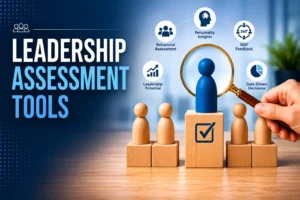
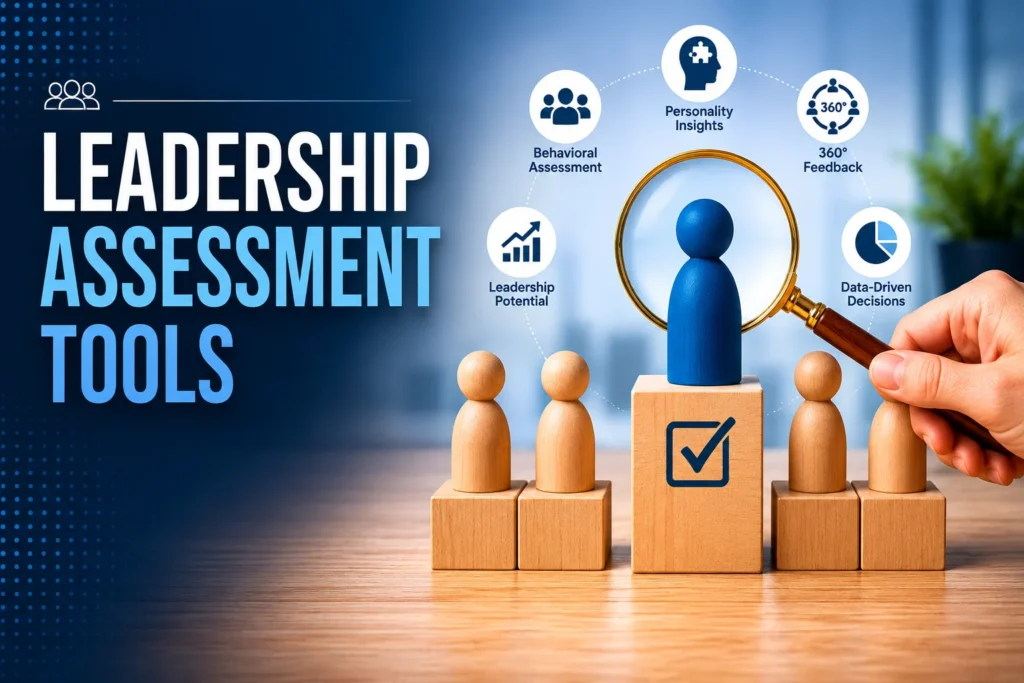
When creating a team from a ground-up approach or looking to build leadership within an existing team, the right leadership assessment tools could be a game changer for successful team-building. If it’s a competitive world and everything is moving at high speeds, the decision for leadership positions should not solely be based on instinct. Assessments can provide valuable data for organizations, and provide them with valuable insights to guide them in the right direction.
This resource will guide you through assessment tools for leaders and give you information on why they are important, how to choose them, the strengths of some of the best ones out there today, and how to apply the results.
What Are Leadership Assessment Tools?
Leadership assessment tools refer to structured instruments, such as questionnaires, which help measure the leadership ability, character traits, behavior patterns, intelligence and interpersonal skills of an individual. Leadership assessment tools offer a perspective on a leader’s current strengths and areas that need improvement.
Leadership assessment tools ensure that a data-driven evaluation of the performance is provided, and not merely an informal one. This helps eliminate any personal biases about the leader, and offers a factual insight into the present standing of the individual.
Using assessment tools can help get insights into what level of development a leader is currently at, and how his future development should be guided. Whether it is to use assessment tools in selecting new employees, developing a succession plan, conducting training needs analysis or building a team, it will help achieve one common goal – a factual insight into the situation.
Why Leadership Assessment Matters More Than Ever
Today’s work environment places greater expectations on its leaders than ever before. The advent of remote work, increased collaboration, fast digital changes, and changing employee requirements have resulted in greater emphasis on what constitutes effective leadership. That is why conducting an effective leadership assessment has now become imperative.
A strong Leadership Assessment system enables organisations to:
- Proactively find and nurture talent before problems occur
- Ensure individual development plans meet business objectives
- Minimize expensive hiring errors with the right leaders.
- Develop awareness of current leaders with specific feedback
- Use real performance data to help with succession planning.
Without reliable assessment tools, companies often rely on outdated models or personal bias to make leadership decisions, and that’s where organisations lose good people and promote the wrong ones.
What Are the Best Leadership Assessment Tools? A Breakdown by Category
When asking what are the best leadership assessment tools, the honest answer is: it depends on what you’re trying to measure. Assessment tools fall into several categories, each designed to illuminate a different dimension of leadership.
1. Personality-Based Assessment Tools
Personality assessment tools explore the traits and dispositions that influence how a leader thinks, acts, and reacts. These are particularly valuable for deepening self-awareness.
- Hogan Personality Inventory (HPI): One of the most highly regarded assessment tools, the Hogan Assessment system consists of the Hogan Personality Inventory, Hogan Development Survey, and the Motives, Values, Preferences Inventory. When used together, these provide an accurate picture of how a leader acts in regular conditions, their behavior under pressure, and their underlying motivation. It is widely used in executive coaching and selection programs.
- Occupational Personality Questionnaire (OPQ) by SHL. The OPQ assesses 32 distinct personality characteristics and is one of the most scientifically validated assessment tools available. SHL has a broad library of assessment tools covering personality, skills, cognitive ability, and behavioural styles, making it a flexible option for enterprise-level leadership assessment.
2. Behavioural Style Assessment Tools
Behavioural assessment tools focus on observable patterns in how leaders interact with others, make decisions, and approach tasks. These are some of the most commonly used leadership assessment tools globally.
- DISC Profile: The DISC leadership assessment tool measures four behavioural dimensions: Dominance, Influence, Steadiness, and Conscientiousness. It helps leaders understand whether they are direct or indirect, task-focused or people-focused, and fast or deliberate in their decision-making. As a self-reported leadership assessment, DISC is accessible and easy to debrief, making it a popular choice for team workshops and manager development programmes.
- Myers-Briggs Type Indicator (MBTI): The MBTI is one of the most widely recognised assessment tools in the world. Based on Carl Jung’s theory of psychological types, this leadership assessment categorises individuals across four dimensions: Extraversion vs Introversion, Sensing vs Intuition, Thinking vs Feeling, and Judging vs Perceiving. While MBTI has its critics in terms of predictive validity, it remains a powerful tool for building self-awareness and improving team communication.
- CliftonStrengths (formerly StrengthsFinder): CliftonStrengths is a type of leadership assessment designed by Gallup based on the principle that leaders develop quickly by working on their strengths rather than improving their weaknesses. The tool divides people into several themes according to four different domains – Executing, Influencing, Relationship Building, and Strategic Thinking.
- Leadership Circle Profile: This is one of the more advanced behavioural leadership assessment tools on the market. It combines self-reporting with 360-degree feedback from others, measuring both creative leadership competencies (those that drive effectiveness) and reactive tendencies (those that limit it). The leadership assessment report provides a visual map of a leader’s impact, and results must be debriefed by a certified Leadership Circle coach.
- Life Styles Inventory (LSI) by Human Synergistics: The LSI is another leadership assessment tool that blends self-reporting with observer feedback. It measures thinking and behavioural styles across a circumplex model and is available in variants for individuals, managers, and leaders specifically. Certification is required to administer and debrief this assessment tool.
- The Birkman Signature: The Birkman is a nuanced leadership assessment that measures nine behaviour components, including Social Energy, Assertiveness, Emotional Energy, and Thought style. It’s particularly valued for understanding how leaders behave when their needs aren’t being met, a blind spot that many other assessment tools miss.
3. Leadership Skills Assessment Tools
A leadership skills assessment goes beyond personality and behaviour to directly measure skill proficiency. Unlike personality-based assessment tools, a leadership skills assessment is specifically designed to identify skill gaps and inform training needs analysis.
Leadership Success Knowledge and Skills Assessment. A scenario-based leadership assessment tool that is based on 40 universal leadership scenarios. The participants select the optimal response to a given scenario and then their responses are compared with those of a larger population. It is designed for emerging leaders, frontline managers and middle managers. Most importantly it is a skills-based assessment and not a personality based assessment, making it an actionable leadership assessment and an accurate indicator of targeted development plans.
A strong leadership skills assessment covers both soft and hard skills, giving learning and development teams the data they need to build truly targeted training rather than one-size-fits-all programmes.
4. Cognitive Ability Assessment Tools
Cognitive assessment tools measure mental processing capabilities, verbal reasoning, numerical ability, problem-solving, and reading comprehension. While these are powerful assessment tools for selection processes, they are not suitable for training needs analysis, as cognitive ability is largely fixed.
Korn Ferry viaEdge Korn Ferry’s suite of assessment tools includes cognitive ability alongside learning agility, personality, and skills assessments. It’s a blended leadership assessment solution used primarily in executive selection and succession planning. Certification is required to access these assessment tools.
Ready to Build Stronger Leaders?
Empower managers and future leaders with practical leadership development programs that improve communication, decision-making, accountability, and team performance.
Contact UsHow to Choose the Right Leadership Assessment Tool
With so many assessment tools available, choosing the right leadership assessment for your organisation requires clarity on two key questions:
- What are you hoping to uncover? Are you trying to build self-awareness in leaders? Identify skill gaps? Select the right candidate for a senior role? Each of these goals calls for different assessment tools.
- What do you want to do with the data? If your leadership assessment data will be used to make high-stakes hiring or firing decisions, the statistical validity of your assessment tools becomes critical. Your leadership assessment tool should be reliable, objective, and free from bias related to gender, race, or socioeconomic background.
If the leadership assessment is for development purposes, building awareness, coaching conversations, or team effectiveness, you may have more flexibility in which assessment tools you choose.
Practical considerations also matter when selecting assessment tools: cost, scalability, and user experience all play a role. The best leadership assessment tools are those that participants actually engage with honestly. If a leadership assessment is too complex or time-consuming, employees will either disengage or try to game the results, which defeats the purpose entirely.
Getting Real Value From Your Leadership Assessment
Running a leadership assessment is only the beginning. The real value comes from what happens after. Here are the key steps to turn leadership assessment data into measurable growth:
- Debrief properly: Many assessment tools require certified practitioners to debrief results, and for good reason. A poorly handled debrief can cause more harm than good. Make sure the person discussing leadership assessment results with the individual is qualified to contextualise the data constructively.
- Link results to development plans: A leadership skills assessment should directly inform a personalised development plan. The gap identified in the assessment tool becomes the starting point for targeted coaching, training, or mentoring.
- Use multiple assessment tools: No single leadership assessment captures the full picture. Combining a leadership skills assessment with a behavioural assessment tool and perhaps a 360-degree feedback instrument gives a much richer view of a leader’s capabilities and blind spots.
- Review and reassess: Leadership assessment isn’t a one-time event. As leaders develop, repeat leadership assessment cycles can track progress, celebrate growth, and identify new areas for focus.
Read More – What Is a Leadership Assessment and Why Your Organization Needs One
Final Thoughts
The question is no longer whether to use leadership assessment tools; it’s which ones to use, and how to use them well. A well-chosen leadership assessment gives individuals the clarity to grow, and organisations the data to invest in the right people in the right ways.
From leadership skills assessment tools that pinpoint training needs to personality-based assessment tools that deepen self-awareness, the landscape of leadership assessment has never been richer. The key is to match your assessment tools to your goals, ensure the process is valid and respectful, and use the results to drive real, meaningful development.
Because at the end of the day, great leaders aren’t just born, they’re built. And the best leadership assessment tools are the blueprint.
Frequently Asked Questions
A leadership assessment tool is a structured method for evaluating an individual's leadership skills, personality traits, behavioural tendencies, or cognitive ability. Leadership assessment tools are used in selection, development, succession planning, and team effectiveness programmes.
The most widely used leadership assessment tools include the DISC Profile, Myers-Briggs Type Indicator (MBTI), CliftonStrengths, Hogan Personality Inventory, Leadership Circle Profile, and scenario-based leadership skills assessment tools like the Leadership Success Assessment.
A general leadership assessment may cover personality, behaviour, cognitive ability, or any combination thereof. A leadership skills assessment specifically targets skill proficiency and gap identification, making it the most appropriate assessment tool for training needs analysis and targeted development planning.
Start by defining what you want to measure and what you'll do with the results. If you're making high-stakes talent decisions, prioritise assessment tools with strong statistical validity. If you're focused on development and self-awareness, a wider range of leadership assessment tools will be appropriate.
Yes. Many assessment tools, particularly behavioural ones like DISC and MBTI, are highly effective in team settings. Sharing leadership assessment results in a group context can build mutual understanding, improve communication, and surface team-level strengths and blind spots.
The validity of assessment tools varies significantly. Established assessment tools like the Hogan, OPQ, and Leadership Circle Profile have strong psychometric validation. Others are more informational. Always research the scientific basis of a leadership assessment tool before using it for significant decisions.