Companies spend a lot of money on personality and behavioural tests to help teams work better together, make leadership stronger, and produce teams that perform excellent work. When HR and L&D leaders look at their options, DISC Assessment and MBTI always stand out. As corporations look for tools that do more than just talk about theory and affect the way people operate, there is more and more controversy regarding DISC vs. Myers-Briggs.
People are getting increasingly interested in DISC vs. MBTI, but not to choose a winner. It truly asks, “What framework works best for the organisation’s goals, culture, and development needs?” Leaders usually look at both DiSC® vs. Myers- Briggs to see which one helps individuals talk to each other better, do their jobs better, and become better leaders.
Everything DiSC® is a research-based usage of the DiSC model that is supposed to help people become more aware of how they act and more flexible at work. On the other side, MBTI® helps us learn about different personality types and how people are different. It is based on the Myers-Briggs scale.
You need to grasp the differences between DISC or Myers-Briggs to make a good choice. The article compares Everything DiSC® vs. MBTI by looking at the facts and the needs of businesses. It helps firms pick the correct test to assist them in reaching their long-term goals and plans for developing talent.
Understanding DiSC and Everything DiSC® in the Workplace
1. What Is DiSC?
These days, the DiSC model is one of the most common methods to think about behaviour in professional development. The DiSC is based on the work of psychologist William Moulton Marston. It looks at how people deal with difficulties, how they affect others, how they keep up with the pace, and how they follow rules or structure. DiSC is different from personality frameworks since it looks at behaviour patterns that may be seen from the outside in the workplace.
The model identifies four primary DiSC styles: Dominance (D), Influence (I), Steadiness (S), and Conscientiousness (C). There are numerous ways to talk, make choices, work together, and solve problems with each DiSC style. It’s crucial that DiSC doesn’t place people in boxes or label them. It doesn’t just give you a way to understand how individuals act and how they can change.
The DiSC is basic and focused on behaviour, so teams can grasp and utilise it right away. When employees talk to each other in meetings, team discussions, and performance reviews, they can immediately adjust how they talk to one another to avoid getting into fights.
2. How Everything DiSC® Expands Traditional DiSC
We can get a rough idea of behaviour from traditional DiSC evaluations, but Everything DiSC® adds research-based validation, relevance to the workplace Culture, and learning experiences that can be scaled up. Businesses made Everything DiSC® a tool. It changes the basic DiSC model into an application-driven tool that lets people work together and get things done better.
One of the best things about Everything DiSC® is that it is made for the workplace. Everything DiSC® not only present a generic behavioural profile; it gives leaders, managers, salesmen, and teams unique answers. Each edition takes these lessons and applies them to real-life professional problems, like how to handle conflict, give criticism, motivate colleagues, and work with people from other departments.
Everything DiSC® includes digital platforms, facilitator tools, and reinforcement resources that help people modify their behaviour for good. This makes it straightforward to utilise in different departments and for learning programs that are open to everyone in the firm. When companies compare DiSC or Myers-Briggs, this practical, work-related growth is typically a key factor in their choices.
3. Why Organisations Use Disc
Companies use DiSC because it gives them immediate value at work. Teams improve communication by using discourse to talk about how people act differently. Leaders usethe DiSC to help them understand themselves better and see how their style affects other people. In performance reviews, a DiSC gives feedback in a neutral framework that makes people less defensive and more likely to have a productive conversation.
For many businesses looking at DISC vs. Myers-Briggs, DISC is a better choice for workplace development projects because it is easy to use and can be applied directly to business through Everything DiSC®.
Understanding MBTI® and Myers-Briggs in Professional Settings
1. What Is MBTI®?
The MBTI® (Myers-Briggs Type Indicator®) is one of the most recognised personality assessments in the world. Invented by Isabel Briggs Myers and Katharine Cook Briggs, the MBTI is based on Carl Jung’s theory of psychological types. Rather than measuring behaviour, the MBTI® explores how individuals prefer to perceive the world and make decisions.
The framework identifies 16 personality types based on four dichotomies: Extraversion–Introversion, Sensing–Intuition, Thinking–Feeling, and Judging–Perceiving. You can learn a lot about how people think, how they interact with others, and how they deal with structure or flexibility by looking at their MBTI type.
The MBTI® gives professionals a structured way to understand how different people think. The MBTI helps people understand that people communicate, make decisions, and solve problems in different ways by identifying their personality types. This psychological basis sets MBTI® apart from models that only look at behaviour.
2. Is MBTI® a Personality Test or Behavioural Assessment?
A frequent inquiry pertains to whether the MBTI® constitutes a personality test or a behavioural evaluation. The MBTI is mostly a personality test based on the theory of psychological preferences. It does not assess observable workplace behaviour in the same manner as behavioral models. Instead, MBTI® looks at how people naturally think, gather information, and make decisions.
This difference is often the main point of discussion when people talk about DISC vs. Myers-Briggs. This is because companies look at how adaptable a person’s behavior is compared to how well they understand their personality when choosing a development framework.
3. Why Organizations Use Myers-Briggs
Many companies use Myers-Briggs to help people learn more about themselves and gain insight into their own lives. The MBTI® is great for coaching, leadership reflection programs, and workshops that help people understand each other better. People can better understand their strengths, limitations, and natural inclinations by looking at personality differences through MBTI.
Myers-Briggs encourages teams to talk about how diverse types might assist the group do well. It can assist teams learn how people think, make choices, and have various amounts of energy.
Many businesses think that MBTI® is a terrific instrument for personal growth and psychological inquiry when comparing DiSC vs. MBTI. The Myers-Briggs Type Indicator (MBTI) wasn’t designed just for the workplace, but people nevertheless value it for helping them learn more about themselves and their teams.
Core Differences: DiSC vs. Myers-Briggs Explained Clearly
When companies compare DiSC or Myers-Briggs, they usually look at how well each one works, how easy it is to use, and how well it fits with the company’s goals. When you look at structure, focus, and workplace orientation, it’s easier to see the differences between DiSC and MBTI, even though both are well-respected.
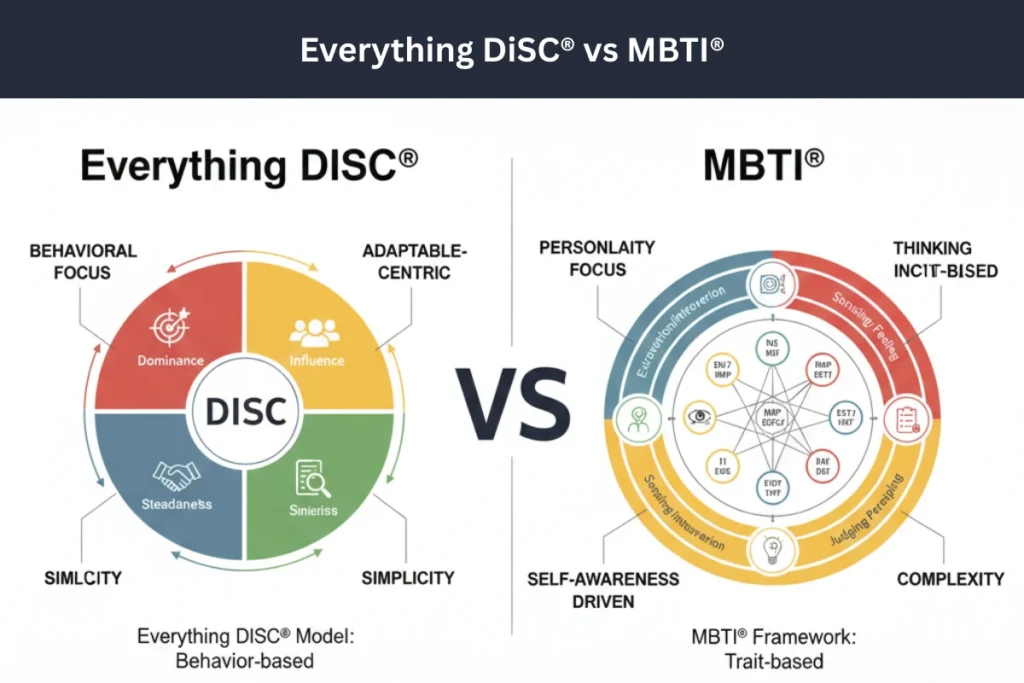
1. Behavioural vs. Personality Focus
The primary distinction between DISC vs. MBTI lies in their respective focal points. The DISC model looks at what people do, especially how they handle problems, how they affect others, how they keep going, and how they interact with structure. DISC is more adaptable since it looks at behaviour rather than identity. People can vary their DiSC style on purpose based on the situation, which is highly useful in places where things are continually changing.
On the other hand, MBTI® is founded on the idea of psychological types. The MBTI framework analyses inherent cognitive predispositions-how individuals process information, make decisions, and distribute their energy. People think that these tastes don’t change much over time.
To grasp the difference between DISC or Myers-Briggs, you need to know the difference between behaviour and personality. When companies seek useful, performance-based information, they usually choose behaviour-based technologies first. However, people may find the psychological perspective of MBTI useful when they wish to learn more about themselves.
2. Simplicity vs Complexity
Another essential factor to think about when comparing DISC or Myers-Briggs is how simple they are to grasp and use. The DISC framework divides behaviour into four basic groups: Dominance, Influence, Steadiness, and Conscientiousness. This makes it easier for teams to acquire the DISC language fast and use it in meetings, feedback sessions, and when they work together.
The MBTI®, on the other hand, uses four pairs of opposites to find 16 different personality types. The MBTI tells you a lot about personality tendencies, but you might need more help understanding it and putting it into practice.
When businesses compare DISC vs. MBTI, they generally find that the simpler one is easier for everyone to adopt right away.
3. Workplace Orientation
When deciding between DiSC® and Myers-Briggs, it’s crucial to think about how well they fit with your job. Everything DiSC® was meant to be used at work. It draws on the classic DiSC model but uses behavioural insights to show how to deal with conflict, how to get people involved, how effectively leaders operate, and how well teams work in the real world.
MBTI®, on the other hand, emerged from psychology studies, not from a corporate plan to boost performance. The Myers-Briggs Type Indicator (MBTI) is a popular tool for career growth, yet it wasn’t meant to be utilised at work.
In the larger argument over DISC vs. Myers-Briggs, this difference in genesis affects how directly each framework relates to measurable commercial results.
4. Practical Comparison Overview
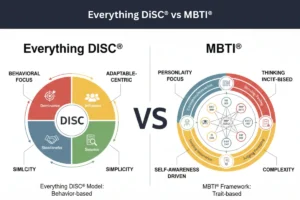
To make the decision between DISC vs. MBTI clearer, here’s a simple comparison of Everything DiSC® and MBTI.®:
- Type of Framework
- Everything DiSC®: A way to measure behaviour based on the DiSC model
- MBTI®: A test of personality based on the theory of psychological types
- How many profiles are there are
- DiSC: Four primary styles with blended variations
- MBTI: Sixteen types of personality in MBTI
- Main Focus
- DiSC: Behaviour that can be seen and changed
- MBTI®: How you think and what you like inside
- Best Fit For
- Everything DiSC®: Improving communication, developing leaders, and working together as a team
- Myers-Briggs: coaching, workshops on self-awareness, and programs for personal growth
- Alignment at Work
- Everything DiSC®: Designed specifically for business performance
- MBTI: A psychological theory that has been changed for use in the workplace
When choosing between DiSC® and Myers-Briggs, an organisation needs to decide if it wants to focus on immediate behavioural application or deeper personality exploration.
Ready to Improve Leadership & Team Performance?
Implement Everything DiSC® to strengthen communication, develop leaders, and drive measurable business results.
Explore SolutionsIs Everything DiSC® Better Than MBTI® for Workplace Training?
HR and L&D leaders often ask, “Is Everything DiSC® better than MBTI® for training at work?” The answer depends a lot on what the program is supposed to do. When the goal is to directly affect leadership behaviour, manager effectiveness, and team performance, Everything DiSC® often offers more structured workplace tools based on the practical foundation of the DiSC model.
Everything DiSC® turns DISC insights into useful strategies in leadership development programs. Leaders learn how their behaviour affects how they make decisions, give orders, and keep people motivated. Leaders can quickly change their approach to get people involved and hold them accountable because DISC focuses on behaviour that can be seen.
Everything DiSC® helps managers be more effective by teaching them real-world skills like giving feedback, handling conflict, and changing how they talk to people. Workshops on conflict management that use discourse help teams figure out what causes certain behaviours and how to respond in a useful way. Because the DISC framework is so clear, it’s easy to use these insights in your daily work.
Everything DiSC® links DISC styles to customer interactions in sales enablement programs. This helps salespeople adjust how they talk to different types of buyers. In the same way, when trying to change a culture, a common language of discourse helps departments work together, trust each other, and be on the same page.
That being said, MBTI® is still useful for training at work, especially when the goal is to learn more about yourself. The MBTI framework promotes contemplation of cognitive inclinations, decision-making methodologies, and personal strengths. It works especially well in coaching sessions and workshops that help people become more aware of themselves.
So, is Everything DiSC® better than MBTI® for training at work? Everything DiSC® often gives businesses more direct results when they want to focus on behaviour and performance. But when the focus is on personal growth and understanding of the mind, MBTI still gives useful information.
Disc vs. MBTI for Hiring and Recruitment
Companies often ask a very important question when they talk about using DISC vs. MBTI for hiring and recruitment: Which test is better for deciding who to hire? Both frameworks give you useful information, but you should think about this topic carefully and strategically.
In the bigger debate about DISC vs. Myers-Briggs, neither test was meant to be used on its own to choose candidates. The DISC model looks at how people act at work, while the MBTI® looks at how people think and what kind of person they are. Using either tool as the only reason to hire someone can cause problems with ethics, the law, and compliance.
When it comes to hiring and recruiting, DISC vs. Myers-Briggs should be seen as a way to help people grow rather than a way to get rid of them. The DISC framework can help businesses figure out what kinds of behaviour are best for certain jobs, like those that need a lot of assertiveness, teamwork, or attention to detail. This insight should, however, go along with structured interviews, competency mapping, and skills-based tests.
In the same way, MBTI can help you understand your personality preferences, but cognitive style alone doesn’t determine how well you do your job. Relying too much on personality type can make it too easy to judge candidates.
For organisations inquiring about which assessment is better for hiring decisions, best practice recommends employing behavioural and personality insights ethically, serving as developmental tools subsequent to hiring rather than as gatekeeping instruments.
At BYLD, tests like Everything DiSC® are mostly used to help leaders grow, teams work better, and people do better at their jobs. When used wisely as part of a larger talent strategy, these tools can help with fair, informed, and compliant hiring and onboarding processes without taking the place of structured selection criteria.
Which Assessment Is Better for Team Communication: Everything DiSC® or MBTI®?
“Which assessment is better for team communication: Everything DiSC® or MBTI®?” is a question that executives often get. How quickly and thoroughly a business wants to change will determine the answer.
The DISC framework looks at how people act to show how they talk to each other in different ways. For instance, a person with a high-D style might like conversations that are short and to the point and focus on getting things done, while a person with a S style might value stability and patience. Teams can quickly change the tone, pace, and message by noticing these DISC tendencies. It is especially helpful to compare DISC or Myers-Briggs when communication issues make performance worse.
People who take part in organised Everything DiSC® team sessions discover how their DISC style impacts how they handle meetings, give and accept feedback, and deal with conflict. Teams practice adjusting how they operate in real-life scenarios, as when they have to cope with tension between teammates who work quickly and those who pay attention to details or communicate ideas to analytical stakeholders. You may make changes right away because Everything DiSC® connects what you learn to how you act at work.
On the other side, MBTI® looks at personality types to help teams. The MBTI can assist teams learn about how people obtain their energy (whether they are introverted or extroverted), how they think, and how they make decisions. This typically leads to more in-depth talks about how people think and get along with each other.
Organisations should think about what they want to get out of using DiSC® or Myers-Briggs to improve communication. The DiSC is generally easier to utilise because it helps people change their behaviour rapidly and use it in real life. MBTI® can help people understand each other better and make team talks more useful. In the end, both the DISC or Myers-Briggs tools can help, but it depends on what kind of communication issues you need to fix.
When Should Organizations Choose DiSC® or Myers-Briggs?
To choose between DiSC® or Myers-Briggs, you need to be clear about your business goals, cultural priorities, and desired results. In a lot of DISC vs Myers-Briggs talks, the best choice has less to do with how popular it is and more to do with how well it fits with the organisation.
Choose Everything DiSC® if:
- You want a workplace app that gives you behaviour-based insights right away.
- You need a solution that can be used by all teams, functions, or the whole company.
- You care about how your business will be affected in measurable ways, like better teamwork, stronger leadership, and better team performance.
Because Everything DiSC® is based on the practical DiSC framework, it turns insights right into action at work. For businesses that put a lot of value on changing behaviour and improving performance, this is often a key factor in whether or not they fit in with the company.
Choose MBTI® if:
- You put a lot of value on exploring the mind and learning more about personality types.
- You are running coaching sessions or reflective leadership programs that help people grow as individuals.
Leaders should make sure that the assessment fits with their development goals as part of their bigger DiSC® or Myers-Briggs decision-making process. The best choice, whether it’s DISC or Myers-Briggs, is the one that helps you reach your strategic goals and build your skills over time.
Why Many Organizations Prefer Everything DiSC® for Business Impact
Many businesses prefer Everything DiSC® in the continuing DISC vs. Myers- Briggs debate because it is intimately linked to measurable business results. Everything DiSC® is built on the research-backed disc structure and blends proven behavioural science with real-world use in the workplace. This makes it particularly relevant for enterprises today.
One of the best things about Everything DiSC® is that it is designed for certain roles. One of the best things about Everything DiSC® is that it is made for certain jobs. It doesn’t just present a broad profile; it gives reports that are customised to leaders, managers, salespeople, and teams. Each solution takes the insights from the DiSC and transforms them into specific plans for improving communication, engagement, accountability, and teamwork.
Another crucial thing to think about is how scalable the business is. You can use Everything DiSC® in every department and at every level of the company. This will make the DiSC a common language. People stay on the same page because of this consistency, and it helps them remember what they learn outside of just one session or intervention.
Everything DiSC® focuses on long-term behaviour modification above all else. Organisations can keep an eye on and encourage improvement over time by focusing on behaviours that can be seen. When firms are trying to choose between DISC and MBTI, Everything DiSC® is frequently considered the better choice for the long term because it helps people become better leaders and do better work.
Read More – How DiSC Assessment Transforms Team Dynamics and Collaboration
Conclusion: Disc vs. Myers-Briggs — It Depends on Your Organisational Goals
The talk about DISC vs. Myers-Briggs isn’t so much about picking a winner as it is about figuring out how to make methods work together. This comparison between Disc or Myers-Briggs reveals that both systems have their unique strengths. The DISC model looks at how people behave and how effectively they can adjust to diverse work settings. The MBTI® model, on the other hand, looks at how people think and how their personalities are different.
Companies need to know what they want to get out of DiSC® and Myers-Briggs before they choose one. Do you want to quickly increase your team’s communication, leadership, and performance? Or do you want to learn more about yourself and improve as a person? The answer helps you choose the proper thing.
In many business environments, Everything DiSC® stands out because it translates DISC insights into tangible, measurable benefits at work. MBTI is still useful for coaching and programs that help people learn more about themselves.
Ultimately, the decision between DISC and MBTI should be based on your culture, your talent strategy, and your long-term goals for your skills.
If you’re considering utilising DiSC® or Myers-Briggs at work, check out solutions that are designed to help people work better together and get more done. Contact BYLD’s assessment professionals to identify the best way to meet your organisation’s needs.