Finding the right person for the team is more than just ticking certain boxes on a resume. In the business world of today, one bad hire can cost a company a lot, not just in hiring fees but also in lost time at work and training. A personality that doesn’t fit in can also hurt the culture, which can stop whole projects and bring down the morale of current employees. A candidate’s technical or “hard” skills get them in the door, but how they act inside the company determines whether they’ll stay and do well there. This is exactly why a comprehensive personality assessment for hiring has become an indispensable part of the talent acquisition toolkit.
Here is where the DiSC assessment for employees comes in as a transformative solution. It is a research-backed methodology designed to figure out how someone will act at work and guess how they will talk, deal with stress, and collaborate with others in your specific team setting. By moving beyond gut feelings and subjective impressions, DiSC for hiring provides a standardized language for behavior. Here is a deep dive into how you can use DiSC for hiring to revolutionize your recruitment and onboarding strategies.
How Recruiters Can Use the DiSC Model for Hiring Decisions
When you break down the DiSC model, it helps you understand the psychological drivers behind how people naturally work together and communicate. For recruiters, this information is gold. It allows for a nuanced matching process that aligns a candidate’s natural behavioral tendencies with the specific environmental needs of a job. By utilizing Everything DiSC® for hiring, recruiters can move away from “hiring in their own image” and toward hiring for the specific needs of the role.
1. Dominance (D): The Results-Driven Leader
People with a high D style are sure of themselves, make decisions quickly, and are very focused on the bottom line. They focus on getting things done right away and are often called direct, forceful, or even blunt.
- Ideal Roles: They excel in leadership positions, outbound sales, or high-pressure executive roles where quick decision-making is critical.
- Hiring Insight: When utilizing DiSC for hiring for a “D” profile, look for their ability to balance their drive with empathy for team members.
2. Influence (i): The Persuasive Communicator
The “i” style is characterized by enthusiasm, optimism, and a high degree of sociability. These individuals are the “people persons” of an organization. They are adept at networking, building rapid rapport, and keeping team spirits high.
- Ideal Roles: They are naturally suited for sales, marketing, public relations, and other roles that require high-energy teamwork and external communication.
- Hiring Insight: A personality assessment for hiring helps identify if an “i” candidate has the necessary follow-through to complement their excellent communication skills.
3. Steadiness (S): The Reliable Team Player
S-types value consistency, stability, and cooperation above all else. They are the dependable listeners who bring a calm, deliberate disposition to the workplace. They are often the glue that holds a department together during times of transition.
- Ideal Roles: They are the “backbone” of customer service, human resources, and routine tasks that require building long-term, trusting relationships.
- Hiring Insight: The DiSC assessment for employees is particularly useful here to ensure that the candidate won’t feel overwhelmed by a high-chaos or rapidly changing environment.
4. Conscientiousness (C): The Detail-Oriented Analyst
People with this personality type care deeply about quality, accuracy, and expertise. They are analytical, organized, and prefer to make decisions centered on logic and verifiable facts rather than emotions.
- Ideal Roles: This type does best in technical jobs that demand a high degree of precision, such as engineering, IT, quality control, or accounting.
- Hiring Insight: Implementing Everything DiSC® for hiring for “C” roles ensures that you find a candidate who finds satisfaction in the “nitty-gritty” details that others might overlook.
Read More – Understanding the DISC®️ Model: Behavioral Styles for Improved Workplace Interaction
Strategic Applications of DiSC for Hiring
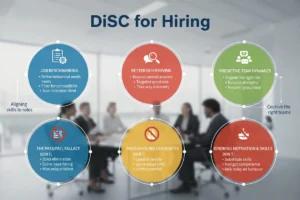
When you carefully use DiSC for hiring, the process of selecting a new team member goes from being a guessing game to a science based on objective data. You can be sure that candidates have both the technical skills and the “behavioral wiring” to do well in the long run. By using Everything DiSC® for hiring, organizations can create a roadmap for a candidate’s future growth from day one.
1. Job Benchmarking: Setting Early Goals for Success
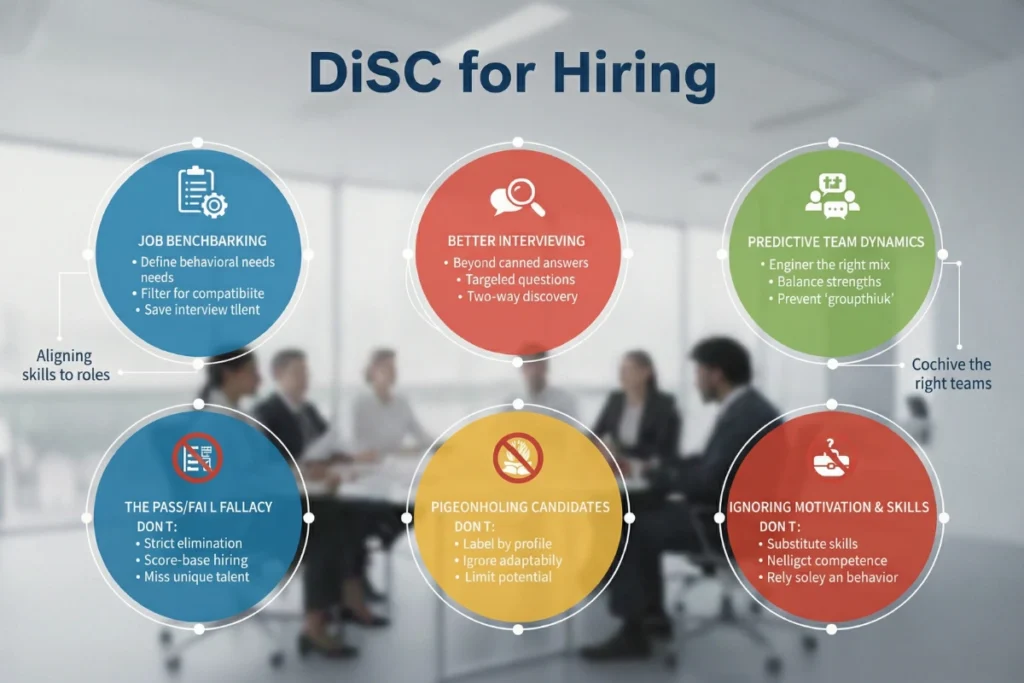
Before you even post a job opening, use Job Benchmarking to find out which behavioral groups (D, i, S, and C) are actually needed for the job to be performed at a high level. This process spells out the “soft skill” requirements, such as how decisive or detail-oriented the person needs to be. This lets you find people whose natural skills match the needs of the job rather than seeking to place a “square peg into a round hole.” By incorporating DiSC for hiring at this early stage, you save hours of interview time by filtering for behavioral compatibility early.
2. Better Behavioral Interviewing: Going Below the Surface
You can avoid using general, “canned” questions in behavioral interviews by using a candidate’s DiSC for hiring report. Standard interviews often allow candidates to give rehearsed answers. However, if you know a candidate’s profile through a personality assessment for hiring, you can dig deeper. For instance, if a high-D (Dominance) candidate is looking for a job that requires a lot of patience and steady routine, you can ask specific questions about how they deal with repetitive tasks and how well they can slow down their pace for the sake of the team. This application of Everything DiSC® for hiring makes the interview a two-way street of honest discovery.
3. Predictive Team Dynamics: Engineering the Right Mix
To find the best mix for your department, DiSC for hiring helps you to picture how a new employee will fit in with the rest of the team before the contract is signed. If your team currently has a surplus of “D” types (drivers), you might intentionally use Everything DiSC® for hiring to find an “S” type (stability) to help keep things in balance and provide administrative support. By encouraging different behaviors, this prevents “groupthink” and eases potential tensions. A DiSC assessment for employees allows a manager to see the “gaps” in the team’s collective personality and hire specifically to fill them.
Read More – The Potential of DiSC® Assessments: A Comprehensive Guide
Working Together to Succeed
The use of DiSC for hiring is a powerful tool, but its effectiveness is doubled when you have professional help to ensure the results are correctly understood and used in an ethical, non-discriminatory way. Everything DiSC® is a premium brand that Wiley has backed up with decades of clinical study, and BYLD Assessment is an official partner for it in India.
By partnering with experts, organizations can use Everything DiSC® for hiring to:
- Identify High-Potential Talent: Use data-driven insights to look beyond the polished resume and find candidates with the specific behavioral traits required for long-term success.
- Build Cohesive Teams: Map existing team dynamics to ensure new hires balance and strengthen the collective group rather than adding to the friction.
BYLD is an expert in assessment-led learning, a method that makes sure the personality test for hiring continues to be useful long after the first day of work. Businesses can make it easier for people to be self-aware and work together by using these insights in ongoing training and leadership development. The DiSC assessment for employees becomes a living document that guides the person’s career path within the company.
How to Avoid Common Mistakes in Behavioral Selection
While DiSC for hiring is a great way to figure out behavioral trends, it is not a crystal ball. If used incorrectly, you could miss out on great talent. These common mistakes should be avoided during the Everything DiSC® for hiring process:
- The “Pass/Fail” Fallacy: NEVER use DiSC to hire people as a strict way to get rid of bad candidates. It’s not meant to be a test with a “score” that you have to get in order to get the job. It’s a tool that’s meant to give you more details and information. Someone who doesn’t exactly fit a “benchmark” might still be the best fit because they have a unique point of view or are very emotionally intelligent.
- Avoiding “Pigeonholing”: People are much more complex than a single letter on a chart. Behavior is adaptable. A DiSC assessment for employees showing a high “C” (Conscientious) individual does not mean they cannot lead a team effectively. Labelling a candidate solely by their profile ignores their ability to learn, grow, and adjust to the work environment.
- Ignoring Motivation and Skills: A perfect behavioral match won’t compensate for a lack of technical competence. A personality assessment for hiring tells you how someone will do the job, but it doesn’t tell you if they can do it. Always use Everything DiSC® for hiring in conjunction with skill tests and structured interviews.
Make Smarter Hiring Decisions with Everything DiSC®
Use behavioral insights to improve interviews, strengthen onboarding, and build high-performing teams with data-backed confidence.
Explore DiSC® for HiringBuilding a Workforce that can Handle the Future
The phrase “culture fit” is used in a vague or biased way a lot of the time these days. But DiSC for hiring makes the process of finding alignment clear and unbiased. By looking at more than just the resume, companies can avoid hiring the wrong person and save a lot of money. They can also look at the candidate’s behavioral “DNA.”
When you match a person’s natural tendencies with their daily tasks, you do more than just fill a seat. In the long run, you also cut down on turnover, conflict, and low morale. Using the DiSC test on employees makes sure that they are understood and put in jobs where they can do their best. You can be sure that Everything DiSC® for hiring is used to build teams that do well in a competitive market if you work with an authorized partner like BYLD Group.
Questions People Ask Often (FAQ)
No, DiSC for hiring is not a 'pass/fail' assessment. Rather, it is a sophisticated tool designed to provide deeper insights into a candidate's natural work style. It should never be the sole basis for a hiring decision; instead, it should be integrated with behavioral interviews and technical skill evaluations to form a holistic view of the candidate
Both are important, but they serve different roles. DiSC is a DiSC assessment for employees that measures observable behavior—how someone acts and communicates in a professional setting. Many think it's easier to apply to daily tasks. MBTI is a personality assessment for hiring that looks at how a person thinks and processes information internally, which is often used for deeper personal reflection.
Yes, as long as it's used in an honest way. It is legal to use everything DiSC to hire people in India and most other places as long as the tests are related to the job requirements and are fair to all candidates. Everything DiSC® is used by many Indian companies to find high-potential employees safely because it focuses on "normal" workplace behaviors.
It is very difficult to do so. Modern tools like Everything DiSC® for hiring use adaptive testing—where the questionnaire changes based on how the candidate answered previous questions—to catch inconsistencies. If a candidate tries to "game" the personality assessment for hiring, the report will often reflect that the data is not consistent.
Not necessarily. The "ideal" team depends on the specific goals of the department. For example, a high-stakes sales team might thrive with more "D" and "i" types, while a quality control team benefits from "C" and "S" types. Using DiSC for hiring helps you achieve the specific synergy your team needs.
Core behavioral styles stay relatively the same in adults. But if an employee has a big event in their life or a big change in their job responsibilities, their DiSC score may show some small changes. Experts say that people should take the test again every two years to make sure that the profile still accurately shows how they work now.