Table of Contents
Here is something most HR consultants figure out the hard way: telling people about personality models is not the same as helping people actually use them. You can explain the theory in a slide deck, mention the four quadrants, and watch the room nod politely. And then nothing changes back at work because the model never moved from concept to real-world habit. That gap, between knowing about a framework and being equipped to deploy it, is exactly what this credential is designed to close.
The this model has been around since the 1920s and has been refined through decades of applied research. It gives people a shared vocabulary for understanding behaviour, communication preferences, and conflict patterns without the judgment that tends to come with less structured feedback. this credential in India is now within reach for professionals across L&D, HR, and consulting, and if you are serious about working with organisational behaviour, it is one of the most practical credentials you can add to what you offer.
What Is DiSC Certification and What Does It Actually Involve?
This qualification is a structured qualification that prepares you to administer, interpret, and facilitate the DiSC assessment with individuals and teams. It is not a theory course where you read about the DiSC framework and sit an exam. It is a practical process that takes you from understanding the model to confidently using it in real facilitation contexts, one-on-one coaching conversations, team workshops, and leadership development programmes.
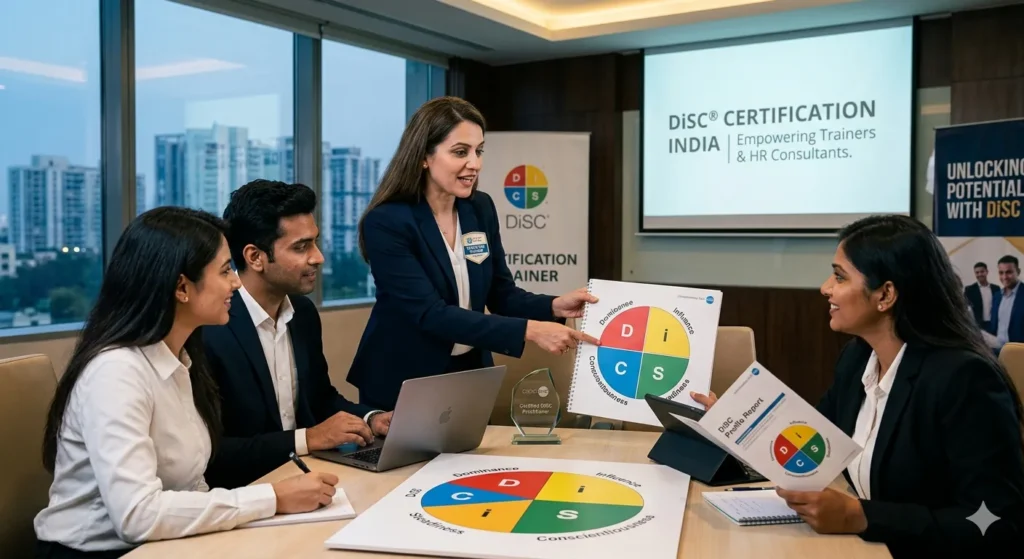
The DiSC trainer certification process covers how to debrief assessment results with individuals in ways that land constructively rather than landing as labels. It covers how to bring the DiSC framework into group settings where people with very different DiSC styles need to understand each other across functional and hierarchical lines. And it covers how to connect assessment insights to real performance challenges rather than leaving the model floating as an interesting thing people did once in an offsite and then forgot.
Most professionals who pursue DiSC Certification come in with either a training background or an HR background, sometimes both. What changes after certification is that they have a methodology they can actually stand behind, a process backed by research, a reporting system that is genuinely interpretable, and a facilitation approach they can apply consistently rather than improvising every time.
Why DiSC Certification in India Makes Sense Right Now
The Indian corporate training and HR consulting market has grown significantly over the last decade. Organisations across sectors, from IT and BFSI to manufacturing and healthcare, are investing in leadership development, team effectiveness, and communication skills programmes in ways that were far less common even five years ago. The demand for structured, research-backed interventions is real. And the supply of practitioners who can deliver them well has not kept pace.
this qualification in India puts you in a position to work in that gap. Certified practitioners are in demand from organisations that have tried generic workshops and found them producing engagement without lasting change. When a facilitator can administer the DiSC framework properly, debrief results with real depth, and connect the insights to the specific dynamics of that team in that moment, the intervention produces a different quality of outcome.
There is also a practical credibility argument for DiSC Certification in India. Corporate buyers of training and consulting services are more discerning than they were a decade ago. ‘I work with personality assessments’ is a very different positioning from ‘I hold a DiSC Certification, which means I’m qualified to administer, interpret, and facilitate the DiSC assessment in professional and organisational contexts.’ The second version invites a different kind of conversation and commands a different fee structure.
Fees for facilitation engagements typically range from ₹50,000 to ₹2,00,000 per session depending on scope, audience size, and the depth of the debrief and coaching component. Certified practitioners consistently command higher positioning than those running generic soft skills programmes without an assessment backbone. DiSC trainer certification is one of the clearest ways to establish that positioning in the Indian market.
Become a Certified DiSC® Practitioner
Move beyond theory and build real facilitation capability with globally recognised DiSC® Certification. Learn to administer, interpret, and deliver impactful workshops that drive behavioural change, improve team dynamics, and elevate your professional credibility in the corporate training and HR space.
Start Your DiSC® Certification JourneyWho Should Be Pursuing DiSC Certification in India?
The straightforward answer is: any professional who works with human behaviour in organisational contexts and wants a robust, evidence-based tool to work with. But let’s be more specific because the way DiSC Certification gets used varies meaningfully depending on where you sit.
Corporate trainers use the DiSC framework to give team workshops real structure and real depth. Instead of running a generic communication skills session, a certified trainer can administer assessments before the workshop, build the entire session around the specific DiSC profiles of the people in the room, and debrief results in a way that generates genuine insight rather than entertaining self-awareness exercises that evaporate by Monday.
HR consultants use DiSC Certification to add diagnostic capability to their interventions. When an organisation comes in asking for help with a team conflict or a leadership pipeline challenge, an HR consultant with DiSC competency can assess the behavioural dynamics of the team systematically rather than relying entirely on interviews and observation. That is a more rigorous starting point and it produces more targeted recommendations.
L&D professionals inside organisations use DiSC Certification in India to build internal capability for ongoing team and leadership development rather than outsourcing every assessment-based intervention. Having an internal certified practitioner changes the economics and the continuity of that work considerably.
Executive coaches use the DiSC framework as part of their coaching engagements to give clients a structured language for understanding their own behavioural preferences and how those preferences land with the people around them. The model works well in one-to-one contexts precisely because it is descriptive rather than evaluative.
What DiSC Certification Actually Gives You to Work With
The tangible outputs of DiSC Certification are worth being specific about because the credential is only part of what you come away with.
You get practitioner-level understanding of how to read and interpret DiSC profiles, including the more nuanced aspects of the model that a surface-level understanding of the four styles misses entirely. Real DiSC Certification gives you the ability to work with style patterns that blend elements of multiple dimensions, to understand how people’s adaptive styles differ from their natural styles under pressure, and to connect those dynamics to specific workplace situations rather than treating profiles as static labels.
You get a structured facilitation methodology for group settings. DiSC trainer certification equips you with approaches for running workshops that produce genuine behaviour insight rather than just self-awareness entertainment. The difference shows up in whether participants leave with specific, actionable changes they are committed to making or with a vague sense that the session was interesting.
You get access to the DiSC assessment platform and the reporting infrastructure that comes with it. When you hold a DiSC Certification, you can administer assessments and generate reports that are far more interpretable and practically useful than generic personality test outputs. The reports support the kind of conversation depth that makes the model valuable over time.
And you get positioning. DiSC trainer certification signals to buyers and clients that your work with behavioural tools is backed by proper preparation rather than self-taught familiarity. In the Indian market, where DiSC Certification is still building its footprint compared to more saturated markets, being a certified practitioner puts you ahead of a significant portion of the market.
Read More – The Benefits of DISC Certification & Why It Matters for Leaders and Organizations
Closing Thoughts
The tools that produce real change in organisations are the ones grounded in research, delivered by people who know them thoroughly, and applied with enough skill that the insights actually translate into different behaviour. DiSC Certification is not the only path to that, but it is one of the clearest and most professionally credible ones available to trainers and HR consultants working in India today.
If you are already working in L&D, HR consulting, or executive coaching and you want a methodology that deepens the quality of your interventions and strengthens your market positioning, DiSC Certification is worth looking at seriously. The investment in the certification pays back through better outcomes for clients, clearer differentiation in a competitive market, and the kind of professional confidence that comes from genuinely knowing what you are doing with a powerful model.
One more thing worth saying directly: the DiSC model is not difficult to learn at a surface level. There are YouTube videos, books, and free primers that will get you fluent in the four styles within a weekend. But fluency in the vocabulary is not the same as competency in the facilitation. The gap shows up in real rooms with real people who have real dynamics between them, where the debrief conversation either produces genuine insight or produces polite nodding that fades by the following week. The difference between those two outcomes is not the model. It is the practitioner. A structured this certification process process is specifically designed to develop that facilitation capability, not just the conceptual understanding. That distinction is worth holding clearly in mind when you are deciding whether the investment makes sense for where you want to take your practice.